
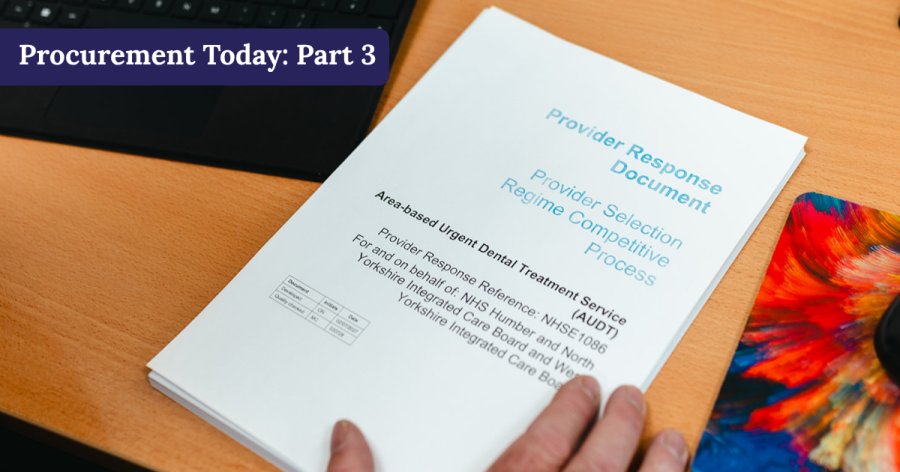
Most bid decisions are made too quickly. Not the final decision to submit, although that is sometimes rushed as well - but the much earlier decision to engage at all. A tender notice appears, it looks relevant, the deadline is some weeks away and before anyone has properly read what is being asked, the organisation is already in the early stages of preparing a response. This is understandable. Tender notices are not always the most readable documents, and there is a natural instinct to move quickly when an opportunity presents itself.
The Competitive Flexible Procedure (CFP), which has become the standard approach for complex public sector procurement under the Procurement Act 2023, produces notices that contain a significant amount of information that is genuinely worth reading carefully before any commitment is made. Getting that reading right does not guarantee a win. Getting it wrong can guarantee a waste of time, money and resource on a bid that was never going to succeed, or worse, on a bid that could have succeeded with a different approach had anyone read what the notice was saying.
Why CFP Notices Deserve More Attention Than Their Predecessors
Under the previous regime, tender notices followed fairly rigid templates and suppliers could develop a reliable sense of where to look for the information that mattered. The CFP changes this in a couple of important ways. First, because the procedure is flexible by design, contracting authorities have considerably more latitude to structure their process in ways that reflect what they are buying. The notice is where that structure is set out, including how many stages there will be, what the selection criteria look like, how dialogue will work and what the final evaluation will be based on. Two CFP notices for apparently similar contracts can look quite different from one another in practice.
Second, the new regime introduces new requirements around transparency and the publication of information that was previously harder to find. Authorities are required to publish more about their procurement approach upfront, which is genuinely useful, but only if you know what you are reading and what to do with it.
The First Things To Read, Before Anything Else
When a tender notice lands, there is a particular sequence of checks that should happen before anyone starts thinking about whether to bid. The contracting authority and the nature of the requirement come first. This sounds obvious, but it is worth being deliberate about. Who is buying this? Is this a central government department, a local authority, an NHS trust, a public corporation? The type of authority matters because it shapes the culture of the procurement, the likely evaluation approach and the kind of evidence that tends to land well. What are they buying? Not what does the title suggest they are buying, but what does the scope section say when you read it carefully?
Next, the estimated value and whether it makes commercial sense for you to pursue it. The contract value in a tender notice is an estimate and sometimes not a very precise one, but it gives you a working number. Is this contract large enough to justify the investment of a serious bid? Is it small enough that your organisation can deliver it without overstretching? Both ends of this question matter. Businesses win contracts they cannot sustain, as well as losing time on contracts that were never going to be commercially viable for them.
Then the timeline. When is the first stage response due? How long is the contract term? Is there an incumbent? The last of these is not always stated explicitly but is often findable with a modest amount of research and it is relevant information. Bidding against an incumbent on a contract where the authority has shown no obvious dissatisfaction requires a different approach than bidding into an open field or where they just want to get rid of an underperforming current contract holder.
Understanding The Process Structure
Under the CFP the notice should set out (at least in outline) how the procurement is going to run. This is one of the most important sections to read carefully and one of the most commonly skim-read. How many stages are there? Is there a formal shortlisting stage and if so, on what basis will it operate? Will there be a dialogue phase and if so, how many rounds? When is the BAFO (Best and Final Offer) expected? Each of these questions has practical implications for how much time and resource you will need to invest, and at what points.
Pay attention to the selection and award criteria which are often presented separately and which serve different functions. Selection criteria determine whether you are allowed through the door: they assess your eligibility and your capability to deliver. Award criteria determine who wins: they assess the quality and value of what you are proposing. Many suppliers read the award criteria carefully and pay less attention to the selection stage, which is a mistake. The selection stage is where organisations are screened out before the substantive competition even begins and the conditions of participation attached to it are worth scrutinising with care.
Check how the award criteria are weighted. What proportion of the evaluation is quality and what proportion is price? Authorities are required to publish this, and it tells you a great deal about what matters to this buyer. A procurement that is weighted sixty percent quality and forty percent price is a different kind of competition than one weighted forty-sixty, and your approach should reflect that difference.
The Red Flags Worth Looking For
Not every tender notice that looks relevant represents a genuine opportunity. Some notices contain signals, not always intentional, that suggest the competition may be less open than it appears. Specifications that are unusually precise in ways that map very closely onto the capabilities of a single known supplier are worth approaching with caution. This does not necessarily indicate impropriety, but it does suggest that the requirement has been shaped by someone with a particular solution in mind and that displacing that solution will require a more compelling argument than simply meeting the specification competently.
Conditions of participation that seem disproportionate to the scale or nature of the contract are another signal. Turnover thresholds that are significantly higher than would be needed to deliver the contract, or requirements for experience that could only be met by a handful of very large organisations, may indicate that the authority has not properly considered the proportionality requirements under the Act, or may indicate that the procurement is effectively pre-decided.
Either way, it is worth thinking carefully before investing in a response. Very short timelines, particularly at the initial selection stage, can disadvantage smaller organisations that do not have bid teams standing by. They can also indicate a procurement that has been planned poorly or, in some cases, one where the authority has a preferred outcome in mind and is moving quickly to reach it. Neither scenario is comfortable for an SME that has to make a genuine resource commitment to participate.
Watch for a mismatch between the stated requirement and the evaluation criteria. If the specification describes a complex, bespoke technical challenge but the evaluation criteria weight price at seventy percent, that is worth noticing. It may mean the authority has not properly aligned its procurement approach with what it actually needs, which has implications for how you position your response and whether the contract, if won, is likely to be a good one.
The Questions To Ask Before You Commit
Before deciding to bid, there is a small number of questions that are worth answering explicitly rather than assuming. Can you actually meet the conditions of participation? If there is a minimum turnover requirement, do you meet it? If there is a requirement for specific accreditations or experience, do you have them? These are binary questions and there is no value in investing in a bid where the answer to any of them is no. Do you genuinely understand what they are asking for? Not at a surface level but in terms of the actual delivery challenge. A tender notice for a managed service contract in a sector you have not worked in before is a different kind of bid than one in your core area of expertise and the time and cost of getting up to speed should be factored into the decision.
Is there a prior market engagement process? Many authorities now run preliminary market engagement before formally launching a procurement. If there has been engagement and you were not involved, it is worth understanding what came out of it. If engagement is still open, participating is almost always worth the time. What is the realistic competitive landscape? Who else is likely to bid? If the contract is likely to attract four or five of your direct competitors alongside you, that is a different risk calculation than one where you have reason to believe the field is thinner. You may not know this with certainty, but the nature of the contract, the authority and the market generally gives you enough to make a reasonable assessment.
Finally - honestly: what is your realistic chance of winning? This is the question people most often avoid answering directly, because optimism is more comfortable than probability. A realistic assessment of your competitive position, based on what you know about your own strengths and weaknesses and what you can read from the notice about what the authority is looking for, is the most useful thing you can do before committing to a bid. Not every opportunity is worth pursuing. The ones that are, deserve your full effort.
How Complete Tenders Can Help Before You Start
The decision of whether to bid - and the thinking that should shape how you approach a bid if you do, is where Complete Tenders adds some of our most useful value. Working through a tender notice properly, identifying the signals that matter, assessing the conditions of participation and forming a realistic view of the competitive position are things that are much easier to do with experienced external input than from inside an organisation that is close to the opportunity and naturally inclined towards optimism.
Complete Tenders offers bid or no-bid support that helps SMEs make that early decision with clarity rather than instinct and, where the decision is to proceed, helps develop an approach that is grounded in what the notice is actually saying rather than what it appears to say at first read. That early work shapes everything that follows - getting it right from the start is considerably easier than correcting course halfway through a multi-stage CFP.
Contact Complete Tenders before your next bid to make sure you are starting from the right place.